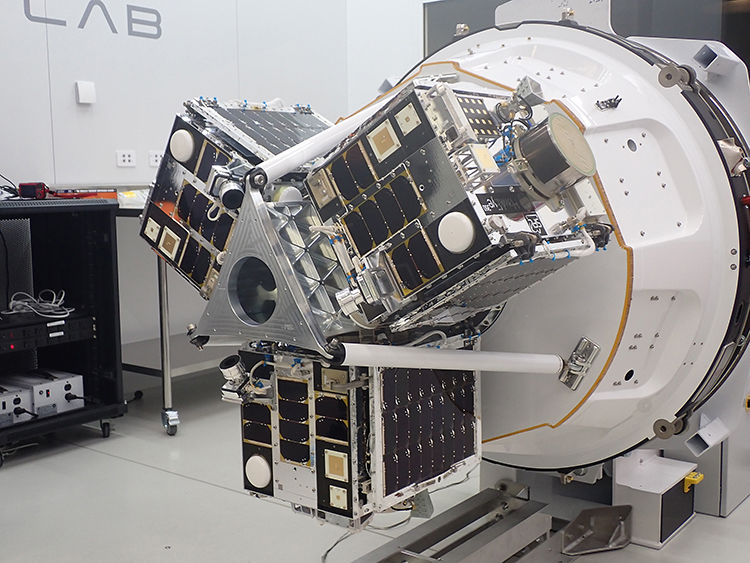
Sidus Space announces successful bus-level commissioning of hybrid 3D printed, AI enhanced LizzieSat-3


Sidus Space has announced the successful bus-level commissioning of its LizzieSat-3 (LS-3) spacecraft. This milestone marks another significant step forward in the Company’s mission to deliver high-value space-based data, integrated sensor solutions, and autonomous on-orbit computing to government and commercial customers.
Following its deployment earlier this year, LS-3 completed all post-launch evaluations, activated critical subsystems, and implemented CUS-GNC's SpacePilot software to enable autonomous navigation and optimized orbital maneuvers. With bus commissioning now finalized, Sidus is continuing with payload commissioning, supporting multiple customer payloads and completing upgrades, enhancements, and mission-specific requirements.
“The complete bus-level commissioning of LizzieSat-3 represents more than bringing another spacecraft online. One of the biggest challenges in remote sensing is keeping pace with rapidly evolving technology once a satellite is in orbit. The successful integration and validation of the autonomous GNC software is a significant advancement, improving pointing accuracy to less than 30 arcseconds (approximately 0.008 degrees) to meet stringent defense and space requirements. Our software-defined mindset allows us to update existing assets on the fly and respond quickly to shifting geopolitical and commercial needs,” said Carol Craig, Founder and CEO of Sidus Space.
Similar to LizzieSat-1 and LizzieSat-2, LS-3 is a multi-mission platform supporting a diverse revenue mix including technology demonstrations, constellation-as-a-service programs, and data-as-a-service contracts. With spacecraft commissioning complete, LS-3 is prepared to deliver AI-driven, on-orbit sensor data processing through the Orlaith AI Platform, powered by FeatherEdge edge computing. The satellite’s sensor suite includes high-resolution imaging systems and an Automatic Identification System (AIS) payload that is already receiving maritime vessel data in near real-time. This supports Sidus’ multi-sensor approach, combining AIS with additional payload inputs to produce timely and actionable insights.
LS-3 is the next evolution in Sidus’ growing constellation and expands on the achievements of LizzieSat-1 and LizzieSat-2, both of which validated Sidus’ core architecture: modular satellite design, rapid integration cycles, resilient on-orbit performance, and customer-driven payload flexibility. LS-3 now adds increased performance, enhanced autonomy, and operational resiliency designed for scalable constellation growth.
Sidus Space continues to expand the LizzieSat constellation, with additional satellites in production and expected to launch in late 2026, to increase capacity and broaden available service offerings. This successful commissioning reaffirms the Company’s commitment to innovation and disciplined execution as it builds a scalable platform to meet rising global demand for space-based data solutions.
“This achievement demonstrates the agility and reliability of our engineering and operations teams,” said Lawrence Hollister, Chief Business Officer of Sidus Space. “Each milestone strengthens our ability to support the Department of Defense, allied sovereign partners, and commercial customers who rely on timely, accurate, and actionable data. LizzieSat-3 reflects our commitment to operational excellence and long-term value creation for shareholders.”
Sidus remains on schedule with its roadmap to expand the LizzieSat multi-mission constellation and integrate the Company’s emerging VPX-based space computing solutions. We believe these advancements will enable higher levels of edge autonomy, near real-time fusion of multi-sensor inputs, and seamless interoperability across terrestrial, maritime, airborne, and space domains.